Saturday, February 1, 2014

Cashew Dark Chocolate Ice Cream (Dairy-Free, Refined Sugar-Free)


Ah, ice cream. It is delicious, easy to serve and can be a great treat, whatever the season. When you decide for whatever reason that you need to avoid consuming dairy, you wonder if you'll be able to eat ice cream again. The good news is that you usually have a lot of options at the grocery store for dairy-free frozen treats. The bad news is that a lot of them suck. Oh, you can stuff yourself full of ice cream made from soy... Except you can't. If you need to avoid dairy, you probably need to avoid soy as well. That soy is also almost certainly GMO. And that doesn't even address the elephant in the room, which is that it tastes horrible. So, you think, I'll just buy some ice "cream" based on coconut milk or almond milk. Until you spot the carageenan as an ingredient. And don't even look at the price tag.

If you want to bypass all that aggravation, you can eat ice cream made with cashew milk. Cashew milk and coconut milk are similar in price to make. But where products made with coconut milk will always taste at least vaguely of coconut, cashews provide a more blank canvas to add other flavors. Years ago, I tried some insanely-expensive chocolate ice cream ($8/cup) made with cashew milk. It was delicious, and inspired me recently to convert this original recipe of mine to dairy-free. You will be pleased to discover it won't break the bank for you, either.

Now here's the thing about making your own ice cream: you need to get the fat content right. Any fool with an ice cream maker can tell you how easy it is to just throw any kind of milk and sweetener into the ice cream bowl and freeze it. In practice, it is not that simple. Ice cream requires fat. That's why it's called ice "cream" and not ice "milk." Sure, you can buy low-fat and even fat-free ice cream at the grocery store. But they use carageenan as a stabilizer, and they have equipment that almost certainly works better than yours. You need fat to make it work. In my experience, the best ice cream comes out when you make the custard using half and half and add heavy whipping cream to it. We aren't using dairy today, but we will work to get the fat content to about the same for both. Let's start with the cashew milk.


Start with a bowl of cashews. You'll need one cup of cashews for about every three cups of milk you need. For regular cashew milk, you'd add four cups of water. Today you will only add two, since you need to make this extra thick to get the fat content right. Soak the cashews overnight, covered, in the fridge. The next day, strain them, rinse them and pour them in the blender.


Blend the heck out of those cashews. Then add about a half-cup of water and blend again. Then add the other 1.5 cups and blend again on high for a couple of minutes. You can strain it with a fine strainer, but I maybe had a half-teaspoon of excess after straining. If you don't mind the occasional tiny piece of cashew in it, I don't think you need to. I ended up with three cups. I reserved one for the custard, one for adding to the mixture later and one to use for something else at another time.

Let's talk about fat content now. Regular half and half has 24 grams of fat in one cup. This double-thick cashew milk has somewhere between 18-26 grams. It's not exact but it worked perfectly well. Heavy whipping cream has 40-48 grams of fat in it. The original recipe called for one cup of heavy cream to be added shortly before freezing. For the second cup of cashew milk mentioned above, I recommend adding 1-2T of extra-virgin coconut oil and blending it together, to boost the fat content. Once you've done that, put that milk covered in the fridge to cool. Let's make the custard now.


Let's start with the chocolate mixture. This is 6T cocoa powder and 6T pure maple syrup (don't you dare use Mrs. Butterworth's), in a four-cup bowl or larger. If you ever decide to increase the recipe, just remember that these two ingredients increase at a 1:1 ratio. Once you've got it mixed together somewhat like frosting, mix in your three egg yolks. Set that aside.


Pour the first cup of cashew milk into a small saucepan. Turn on the heat to medium-high. You want to get the temperature to about 180 degrees. It will not take long at all.


Once it has hit 170-180degF, turn the heat down to medium-low. Take one ladle-full of the cashew milk and pour it slowly into the chocolate mixture bowl, whisking continuously. This allows the temperature of the egg yolks to rise slowly enough that they do not harden (like scrambled eggs, which would be a horrible texture for this). Once you have mixed it thoroughly in the bowl, slowly scrape the contents of the bowl into the saucepan, whisking continuously. Return the heat to medium-high and whisk continuously until the custard begins bubbling. Remove from heat and allow to cool.


Once the custard has cooled, I like to pour it back into the bowl I was using to make the chocolate mixture. But since it had raw eggs in it, I usually wash it first. Cover the custard and put it in the fridge to cool. Once both the custard and the cashew milk/coconut oil mixture have reached a temperature below 40degF, whisk them together and return them to the fridge until you are ready to make the ice cream (which you should do within an hour of this last task).


It's pretty easy from here. Scrape the ice cream mixture into the freezing bowl, and turn on the ice cream maker.


When I made this, it took almost no time to freeze. It was surprisingly quick, around 10-15 minutes. If you double the recipe, it may take a little longer. It's hard to wait around while the custard cools in the fridge, but you're better off if you give it that time to get down to 35 or even 30 degrees. It freezes that much easier.


It's done! And it is so tasty. We couldn't tell that it didn't have dairy in it, because the fat gave it such a smooth texture. This recipe makes about 3-3.5 cups of ice cream, so you may want to double it if you want more leftovers.

Cashew Milk Chocolate Ice Cream
Cashew Milk
1 cup raw cashew pieces
2 cups water
Soak cashews covered overnight in the fridge. Rinse and strain. Blend in blender with water until completely smooth. Divide into three one-cup portions.

Cashew "Whipping Cream"
Return one cup of the cashew milk to blender with 1-2T of extra-virgin coconut oil. Blend until completely incorporated. Cool covered in the fridge.

Chocolate Custard
6T maple syrup
6T cocoa powder
3 egg yolks
Whisk ingredients together in four-cup or larger bowl. Put one cup of cashew milk into small saucepan, on medium-high heat. When temperature reaches 180degF, turn heat to medium-low. Pour one ladle-full into chocolate mixture, whisking continuously. Scrape contents of bowl into saucepan, whisking continuously. Return heat to medium-high until custard begins bubbling. Cool, cover and refrigerate until <40degF. Whisk together with cashew milk/coconut oil mixture and return to refrigerator. Pour ice cream mixture into ice cream maker and freeze according to instructions.

Makes 3-3.5 cups ice cream.

Sunday, January 12, 2014

Finally! Easy Coconut Milk

I absolutely love coconut milk. As a fan of regular old cow's milk, you might wonder why I would even bother. And yet, it makes a lot of sense. If you're trying to make the switch away from dairy or carbs for whatever reason, coconut milk makes for a pretty easy switch. It's rich and creamy, which means that it feels like you're drinking whole milk. It has some saturated fat, but it's the good medium-chain saturated fats that experts believe may boost your metabolism. Plus, unsweetened coconut milk has no sugar in it. None. Unlike the 8 grams you'll get in a cup of cow's milk.

You may know by now that I love to make things myself, whenever I can. Some alternate milks (I'm looking at you, almond) may not be cheaper to make it yourself. But coconut milk made at home can save you a bundle, and give you a useful by-product while you're at it. Plus it tastes a whole lot better. If you've had store-bought coconut milk, chances are it has carageenan in it. I'm not sure what I think about the rumors that carageenan causes cancer, but there are other reasons to avoid it as an ingredient in your milk of choice. It stabilizes the milk so the fat does not separate. But at the same time, it adds a somewhat slimy texture. I didn't notice it years ago when I went DF for awhile and bought the coconut milk. But now that I know the difference, I want the unadulterated coconut milk.

The thing about making your own coconut milk is that most recipes don't take your blender into consideration. Believe me, it matters. If you have a Vitamix like mine, which has a wand, you can make it more efficiently than the average instructions. And if you have a dirt-cheap mixer you bought when you were 18, you need to follow different directions as well. They may tell you that you have to soak or boil your coconut first. You don't. Try my instructions, and see how it works for you.


Let's get started! First you need to get your tools together. Pictured is my blender carafe (Vitamix), a four-cup measure, a half-cup measure, a fine mesh strainer and a spoon. Not pictured (d'oh!) is a small bowl to collect the coconut fiber, and something airtight to store the milk in once you're done.


The first thing you want to do is scoop the unsweetened dried coconut into the carafe. You want 1/2-3/4 of a cup, depending on how creamy you want the finished product. Note: I have made sweetened coconut milk this way using sweetened dried coconut. If you don't care what sweetener you use, you can do it that way. It actually makes the coconut milk perfectly sweet, not overdone. If you have a Vitamix like I do, you can leave the coconut dry. If not, add a cup or so of hot water. Mix on high for a minute or two (which is longer than it sounds).


When you're done, it will look nice and pasty. Now, add water. If you blended the coconut dry, add four cups. If you added water to the last step, add three cups. Whether the water must be hot depends on the power of your blender. With a Vitamix or a BlendTec or something similar, it can be cold or room-temperature water. Once you've added the water, blend on high for at least three minutes.


Now it's ready to strain. Pour the contents of the blender out over your mesh strainer, which should be positioned over a measuring cup of at least four cups.


As you pour in the liquid, the strainer will catch the excess coconut fiber. Use the spoon to help the liquid pass, and squeeze out the milk from the fiber.


If the strainer gets full, scoop out the fiber and put it in a bowl.


 Once you've gone through all the contents of the blender, you'll have 3.5-4 cups of coconut milk. I like to store mine in a Mason jar in the fridge. It will stay good in the fridge for several days. What's left in the bowl is awesome, as well. That technically is coconut flour, before it has been dried. If you want to dry the coconut fiber into coconut flour, you can put it on a pan and roast it in the oven at 200 degrees F until it's dry. Then you can spin it in your food processor and store it that way. Otherwise, I just store it in the fridge until I have a good opportunity to use it. The wet coconut "flour" is an excellent way to make my fabulous Gluten-Free Dairy-Free Brownies.


So that's all it takes! Depending on where you get your coconut, this can be a reasonable deal or an excellent deal. The most I've paid for coconut is about $6/lb. One pound of dried coconut makes about four quarts of coconut milk, with probably 1-1.5 cups of the wet coconut fiber leftover. But I've easily found it for half the price as well. Just shop around and you'll find something. No matter what, when you compare it to $3+ for a half-gallon in the stores, you'll be spending much less to make it from home. Enjoy!

Homemade Coconut Milk
1/2-3/4 cup unsweetened dried coconut
4 cups water

Put coconut in a dry blender. Add one cup of (hot) water as necessary. Blend on high until dried coconut has a pasty consistency. Then, add water to a total of four cups. Blend on high for at least three minutes. Pour contents of blender through a fine mesh strainer into a medium-size bowl or large measuring cup. Reserve excess coconut fiber for other uses. Pour strained coconut milk into airtight container, store in the fridge.


Saturday, January 4, 2014

Gluten-Free, Dairy-Free Brownies

 
I know what you're thinking. You saw "gluten-free" and thought that the whole manner of this blog had gone awry. These are bound to taste terrible, right? Or they'll be sweet and chocolatey but have the vague taste of beans that most GF flours have, right? Wrong. These brownies are so freaking delicious you'll be eating them hand over fist. And I would not be able to keep my foodie badge if I wasn't interested in trying some interesting substitutions. So let's get to it!

It starts with a very interesting fundamental observation I have made. Cocoa powder is awesome. It has a great deal of fiber, but is comparatively low in carbohydrates. In some recipes, it can mimic flour. In some recipes, it can replace flour. But let me back up a bit. For awhile now, I have been making my own coconut milk. Every time I did, I ended up with about a half-cup of wet coconut fiber that just sat in my fridge until I threw it into some muffin recipe or into a smoothie. Little did I know that coconut flour is nothing more than that wet coconut fiber, dried in the oven on a low temperature.

I have a hard time trusting GF flours. It's mostly that I want to be able to make it myself. So coconut flour I had already made seemed like a sure bet. If you have ever read about coconut flour, you probably know that it absorbs a lot of liquid. I have a bit of a trick to get out of this mess: don't dry it out in the first place. If it's already soaked, it won't absorb as much. So it is with this recipe.

All right, back to our love of cocoa powder. To test out my coconut flour, I needed a recipe that called for comparatively little flour, so I wouldn't have to do a lot of additions. I find that this recipe from Alton Brown is inspired. 1.25 cups of cocoa powder, and 0.5 cup of all-purpose. SUBSTITUTION: I used the wet "coconut flour" in place of the AP. In retrospect, I could probably have just used more cocoa powder. But there you have it.


So you start out as you usually would, creaming the oil and sugar together. SUBSTITUTION: I used 8 oz of EVCO instead of butter. I'm using sugar according to the recipe, but you could make your substitutions here as necessary. I've used turbinado sugar (spun finer in my Vitamix) with fine results. If you want to use a liquid sweetener such as maple syrup or honey, you may need to tweak the dry ingredients to get the right consistency. Then add the eggs and mix for 30 seconds or so. Now is also a good time to preheat your oven to 300.

I just dumped in the coconut flour and the vanilla right after.


Then it's time to get the dry ingredients. Cocoa powder and salt, that's it. You don't need any chemical leavening for this recipe, which is pretty awesome.


Mix it together until you get a pretty thick consistency. Feel free to add more cocoa powder if necessary, but I wouldn't go too crazy.


Now to get it in the pan. I use a cupcake tin. And really, that is a genius idea. You get the lovely crusty edges all the way around the brownie, and it's easy to get out of the pan. Spray or oil the tin, and use a scoop to put the batter in. Looks fantastic, doesn't it? Just wait until it's done.


Now take a look at THAT.


Fabulous, isn't it? I love that I get a fantastically chewy brownie that has no flour and no dairy in it. If you feel like the coconut flavor is a little strong (which is not my problem, but it bothers some people), use coconut oil that doesn't have coconut flavor to it.

Wet Ingredients
1 cup sugar, sifted
1 cup brown sugar, sifted
8 ounces EVCO
4 large eggs
2 teaspoons vanilla extract
1/3-1/2 cup wet "coconut flour"
Dry Ingredients
1 3/4 cups cocoa, sifted
1/2 teaspoon kosher salt

Preheat oven to 300 degrees F. Cream first wet ingredients, add the remaining wet ingredients. Incorporate dry ingredients. Mix until consistency is thick. Scoop into oiled cupcake tin and bake for 30-35 minutes.

Monday, March 25, 2013

Chocolate Stout Ice Cream


I don't have many pics of this, because I only just made up the recipe today. I don't usually take pics on the first try, since I'm so focused on getting it to turn out right. It turned out wonderfully, with a very deep flavor profile.

My inspiration for this ice cream was the chocolate stout cupcakes I made today. As I always do, I tasted a tiny bit of the batter before I scooped it into the cups and put it in the oven. If you consider the other ice cream recipes I've made up (dark chocolate brownie, red velvet cake), you shouldn't be surprised that they, too, came from tasting batter and wishing it could be ice cream.

So, go out and get yourself a nice beer. Get more than one bottle, especially if you want to try those cupcakes, too. I'm going for a dark, sweet stout here. I hear tell there's a wonderful double-chocolate stout out there, but there are serious limitations on alcohol here in Utah, so I haven't been able to find it yet. Today, I used Samuel Adams Cream Stout. Pour out one cup of it. I used an Oxo 1-cup measure and poured slowly, letting the foam settle.

Now you're going to set some stuff aside. In a small mixing bowl (I'd say 4-6 cups ought to do it), mix 1 cup sugar, 1/2 c cocoa powder and 6 egg yolks. Set them aside.

The foam ought to be just about gone on the stout. Pour the stout into a small saucepan, along with one cup of half and half. Turn on the stove to medium high. Whisk frequently, until the temperature reaches 180 degrees F, enough to coat the back of a steel spoon.

Transfer 1/2-1 cup of the stout-half and half mixture to the mixing bowl, stirring constantly. Once it has been incorporated, pour the contents of the mixing bowl back into the saucepan. Cook on medium-low heat, stirring frequently, for a couple minutes until it has thickened a little. Remove from heat, and allow to cool for a minute or two.

Pour into a clean bowl or container. Whisk in the cold sour cream. Refrigerate until temperature reaches 40 degrees F.

Mix together chocolate mixture, heavy whipping cream, and bailey's irish cream immediately prior to freezing. Freeze according to your machine's instructions.

If you give it a try, let me know how you liked it!

1c stout
1c half and half
1 c sugar
1/2 c cocoa powder
6 egg yolks
3/4 c sour cream
1.5 cups heavy whipping cream
1.5 T bailey's irish cream

Wednesday, December 19, 2012

Foodie Inspiration: Spiral-Roll Sugar Cookies


This is one of the first recipes I found online and just made it my own. I don't remember exactly when I found it, but it was probably around Christmas, 1998. Wow, 14 years ago! I have made this exact recipe countless times since then. I haven't seen a need to tweak it, so here it is:

http://www.cookingcache.com/dessert/sugarcookies4.shtml?rdid=rc1

Whoever Martha F. is, I've been very, very happy she submitted this recipe.

Back in 1998 (when I was 20, and had nowhere near as nice of a kitchen as I have now), I needed recipes that were as simple as possible. I chose this recipe off this website because the other sugar cookie recipes called for buttermilk, or sour cream, or even cream of tartar (which I never had at the time). Since I moved out on my own, and actually since I was a kid, I have gravitated toward recipes that allow me to use what I already have, instead of necessitating a special trip to the grocery store. I'm not usually patient enough to wait that long. This recipe seemed simple enough to me, so I went with it.

I'm trying a different spin on it this time, though. In the past, I've just rolled it out and then added frosting and/or sprinkles. This time, I'm splitting it up, dyeing the dough, and rolling it up to create cookies you can slice and bake.

As usual, get all your ingredients and equipment together. Then, put your butter and sugar into the mixing bowl and get it going. As it mixes, add the eggs and vanilla:


While they are mixing, get your dry ingredients together:


Then, add your dry mixture slowly (about 1/4-1/2 cup at a time). It should be fairly thick by the time you're done.


Now, separate half the cookie dough into a bowl.


Add a 1/4 tsp of gel food coloring (or as many drops of liquid food colors as necessary) and stir it with a fork. If any of the colors you will be making are red, do that color in the separated bowl. I just find it's easier to get most other colors out of equipment. Red is harder, for some reason.


I mixed the green in the bowl. Scoop the green into a smaller bowl. Cover both bowls (I like aluminum foil) and refrigerate for at least 30 minutes.


Remove the bowls from the fridge and uncover. You can see I made a lot less red than green here. No particular reason, I was in a big hurry, as I usually am, so I didn't split the dough evenly in half. No big deal, I will just use the leftover green for something else. If you did the same thing, just make sure that both dough balls you're working with for this project are essentially the same size.


Flour a cutting board (or wherever you plan to roll out the dough), and get your rolling pin ready.


Roll out your dough. Aim for a rectangle shape, and try to get the dough about 1/3" thick.


If you're finding that it's getting oddly-shaped, just fold over edges and flatten them out again until you have an approximate rectangle shape. Carefully (and I do mean carefully, this is not easy) transfer this to a plate, or use another cutting board for the green. Roll out the green dough in the same way, then layer one on top of the other.


Roll them together along the long side. Once you've finished rolling it up, press the "seam" over so that it's less likely to come undone. Wrap up (I just used leftover foil from the bowls) and refrigerate for at least 30 minutes, but longer is probably a better idea if you can.


Unwrap the dough and put it back on the floured board. Using a sharp knife, cut slices of the dough no more than 1/2" thick.


The dough will warm up quickly, particularly if you only refrigerated it for 30 minutes. So slice the roll quickly and separate the slices from each other.


Place them onto a greased cookie sheet. Bake at 375 for about 10-12 minutes. Substitution: I mostly use Pampered Chef stoneware to bake. It takes longer to heat, so it takes longer to bake. This recipe says 6-8 minutes to bake, and even when I use a metal cookie sheet, it still takes longer. This batch took 14 minutes, but it shouldn't take you as long if you're using metal. Once you get a feel for your oven and your bakeware and making cookies in general, you'll have a good idea how long it takes to bake them.


They're done! Don't they look yummy?


If you want to frost them, I can recommend my own cream cheese frosting. I have never used the frosting recipe on the recipe page because I don't trust raw egg whites. Today, I'm just using frosting I had from last week, so I won't have pics, but here's my easy recipe at the bottom of the page.

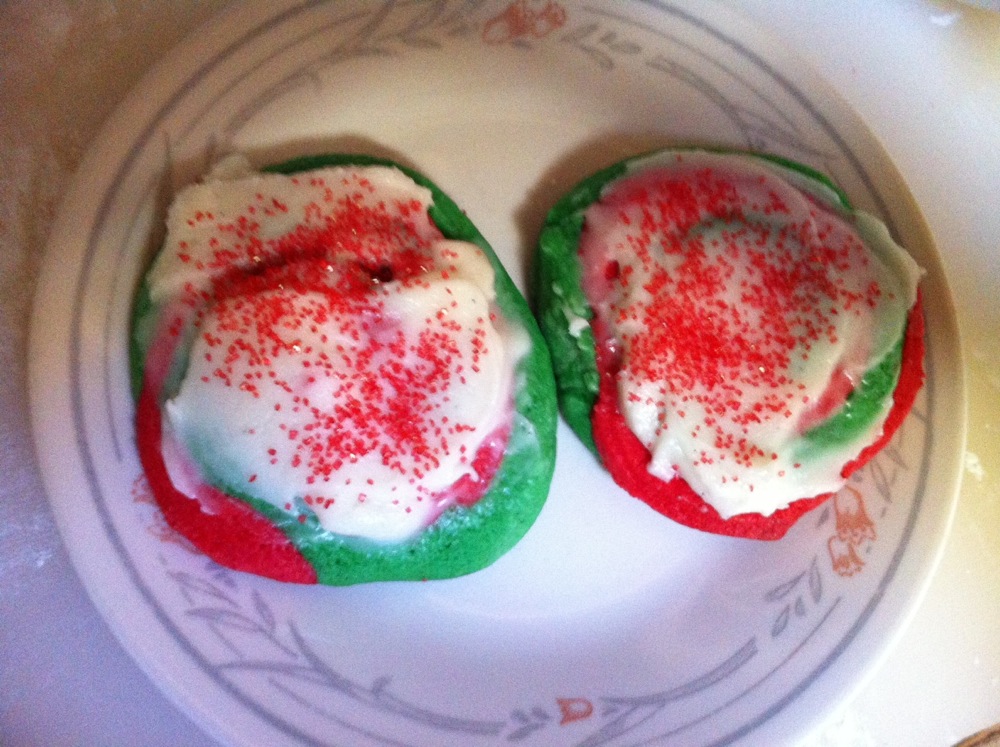
You can see a pic of them at the top with a little frosting and some red sanding sugar. Enjoy!

Easy Vanilla Bean Cream Cheese Frosting

1 stick (1/2 cup) butter
8 oz cream cheese
1 32 oz package powdered sugar (7-8 cups)
1 tsp vanilla or 2 tsp vanilla bean paste (the paste adds those beautiful vanilla bean flecks)
Milk or cream as necessary

Soften the butter and cream cheese. DO NOT MELT. You want it soft enough that the mixer can beat them together smoothly, but firm enough that the frosting doesn't take on a ganache quality. Mix them together until smooth and fluffy. Add the vanilla bean paste or vanilla. Slowly add the powdered sugar, one cup at a time for the first half, then 1/4-1/2 cup. Add the powdered sugar until the frosting stops absorbing it. Scoop into a bowl and refrigerate for at least two hours. To soften for spreading, mix again in the mixer and add milk or cream as necessary for consistency.

Sunday, December 16, 2012

Foodie Inspiration: Light Wheat Bread

In essence, this is the recipe that turned me into a foodie. I'm not posting a link because I've tweaked it so many times it does not resemble at all the original recipe I started with two years ago. You can see, of course, the full recipe at the bottom of this post.

I love baking bread. There's something inherently wholesome and natural about it. The smell of the yeast as it rises, the smell of the bread baking in the oven. These are things that Sean and I have come to love. A little over a year ago, I decided that I was going to start making bread for our family as a regular occurrence instead of a special treat. Fast-forward 13 months, and I wouldn't have it any other way. It's not just for taste and enjoyment of doing something on my own; this is a nice cost-saving measure. I've estimated each loaf costs me around $2 apiece. This bread is comparable to Great Harvest, which charges around $5-$6 per loaf. So I get better bread with less money. Let's get to work.

Get your mixer and dough hook. You can do this by hand, but I prefer a mixer to save time and my achy joints. You'll start by putting the cup of warm water (not hot), 1-2 tablespoons of yeast, and honey into the bowl. Philosophical note: some bakers think that using too much yeast is a big problem. I haven't noticed a difference in the quality of this bread whether I use a teaspoon or two tablespoons of yeast. So until I see a problem, I will continue to do it this way because it rises better in a much shorter period of time. As you'll read many, many times in this blog, I'm in a hurry.

Then stir it up with a fork and allow it to rest for ten minutes or so.


While you're waiting for the yeast to feast on the honey, take some time to get your other ingredients ready. You are going to need four cups of flour. The bread I'm making today is light wheat. That means I will add 2.5 cups of bread flour, and 1.5 cups of whole wheat flour. I am very pleased that I am grinding my own wheat flour now. If you have the option, it's a great idea. Freshly-ground flour (this was ground on Wednesday) makes a big difference.

On flour: yes, it has to be bread flour. It cannot be all-purpose or, heaven forbid, cake flour. Bread flour has a higher protein (gluten) content. If you use a flour that has a lower protein content, the consistency of your bread will not be as nice and it will not rise as well. The bread flour I prefer is King Arthur Unbleached Bread Flour. It has a protein content of 12-14%. The wheat flour I use (or if you wanted to by some King Arthur or Bob's Red Mill) has a similar protein content.

Optional Substitutions: I have made four different varieties of this bread with the same basic recipe. First, you can use all bread flour and make a white loaf. Second, you can do as I'm doing and make light wheat (2.5 cups bread flour, 1.5 cups whole wheat flour). Third, you can do the same, only use oat flour instead of whole wheat. Finally, you can use exclusively whole wheat flour. Although I have found this last variety usually translates into one loaf instead of the two you'll get from the other varieties. If you want to double the recipe, it will work easily for the first three varieties. I have a KitchenAid Pro 600 series mixer, and my mixer has timed out mid-knead the couple times I've tried to double this recipe when making bread using only whole wheat flour. Better to make it twice then try to force your mixer to accommodate eight cups of whole wheat flour.


Now, you'll crack the eggs into a separate bowl. And it seems the good folks at Nichol's Farms don't want me to forget the expiration date:


Crack them into a separate bowl, making sure to remove any tiny pieces of shell. (You can see a tiny piece on the upper left side of this bowl. I did remove that before they went into the mixing bowl.)


Your yeast mixture is ready when it looks like this, nice and foamy.


Pour the eggs in and start the mixer, around setting 3. Add half the flour quickly, and allow it to start to mix together.


Slowly add the second half, 1/4 cup at a time. Optional Substitution: if you'd like to add butter to this recipe, now is the time. If I want a bread that is nice and butter for rolls or hamburger or hot dog buns, I will add two tablespoons (1/4 stick) of softened, not melted, butter. Please note that you may need to add up to a half-cup more bread flour to get the right consistency.


As the dough starts to pull together, it will begin to pull away from the sides of the bowl. At this point, only add a tablespoon or two of flour at a time, waiting until it is fully incorporated to add more.


This is what it looks like once it's fully mixed. You can see that it's almost pulled completely away from the bowl and the dough hook.


When you press into the dough with your fingertip, it should spring back reasonably quickly and not be sticky. If it's still very sticky (i.e. you pull your finger away and there's dough all over it), add more flour and resume kneading.


Once you're done, transfer it to a bowl that has been sprayed or oiled and floured and cover it with a damp cloth. I often use the same mixing bowl, and just sprinkle some flour on top of it. Let it rise until doubled, which should take 45-90 minutes depending on the flour and how warm your house is.


Yay, it's doubled! I used a smaller bowl for this, so if you left it in a large mixing bowl it might not look this big. Just look for it to have doubled in size.


Now we're going to knead it. I just collapse the air out of it and then just kind of smash it in a ball with my hands for as long as I can stand it. I usually knead for a minute or so. Some recipes say you must knead for 5-10 minutes each time. So far, I haven't found a problem with the consistency of my bread. That could be that I let it rise two times before proofing, I'm not sure.


Now, I use a pastry separator to split the dough into two. Put them in two pans that have been sprayed or oiled and floured, and cover again with a damp cloth. Wait until they have doubled.


Now, they've doubled.


Grease and flour two loaf pans to accommodate them.


Next, stretch out the dough slowly. If you see it starting to tear, you're pulling it too far. Stretch it into a rectangle and then roll it up the long side. This allows for a more consistent texture for the loaf. Place the roll into the pan. The last stage of rising is called "proofing." Allow it to rise at least to 0.5-1" above the rim of the pan. These are a little small today, so that will be more than double. When they're almost done, preheat your oven to 350.


They're ready to go in the oven!


You might consider doing a wash for the top. A water wash (don't use too much! Just a light brushing) will create a soft crust. A butter wash will create a flakier, brown crust. An egg wash will create a harder, darker-brown crust. For the butter wash, just melt a tablespoon of butter into a bowl:


Then, brush it on gently with a basting brush.


If you want to do an egg wash, just beat a single raw egg in a bowl and brush it on the same way. When the oven is preheated, put them in the oven (same rack is fine, middle level) for 25 minutes.


They're done! You can tell they are done by tapping on the crust. If it sounds hollow, you're good to go. These ended up a little smaller than usual. I can usually expect the loaves to be similar to regular store-bought sandwich bread, in size. It took less flour to reach optimum elasticity today, so I'm guessing that's the culprit. Allow the loaves to cool as long as you can stand it. Then, enjoy!


If you're wondering what this might look like with an egg wash, here you are. Coincidentally, this is the first time I ever made this kind of bread, and the first bread I'd baked in several years. The fact that it turned out so well and so beautiful on the first try ought to demonstrate that this really is an insanely easy recipe with great results.


Light Wheat Bread Recipe
1-2 tablespoons active dry yeast
1 cup warm (not hot) water
1/3 cup honey

Put these three together and let them sit in the bowl for about ten minutes until it starts to get foamy on top. Then get out the other ingredients.

Three eggs
1/2 t. salt
4 cups bread flour (or 2.5 cups bread flour, 1.5 cups whole wheat flour; or 4 cups whole wheat flour)

Mix it all together with a bread hook (or knead by hand) until it is nice and elastic. Put it into a metal bowl that has been greased and floured. Let rise covered with a damp towel until doubled. Punch down, knead for as long as you can stand it. Let rise covered again until doubled. Divide in half, put in loaf pans that have been oiled and floured (or just on a cookie sheet, for artisan-bread style). Let rise one more time, this time uncovered. Bake at 350 until it's golden brown, around 25-30 minutes.